



Qualifying Alternate Manufacturers and Suppliers
Are we doing this well enough? Or just well enough on paper!!
If you are reading this, you almost certainly do not need to be told what supplier qualification is. You might have written the SOPs or sat through the management reviews, or defended your approved supplier list to a regulatory inspector who wanted to understand your risk stratification logic and you have probably, at some point, had that uncomfortable conversation with a commercial colleague about why a supplier cannot be approved on the basis of a self-assessment questionnaire and a certificate of analysis only.
It is an open and professional discussion about whether the pharmaceutical industry’s method of qualifying alternative suppliers and manufacturers is truly appropriate for the job or whether, in many organizations, it continues to be a structured documentation exercise that falls far short of what the supply chain actually requires.
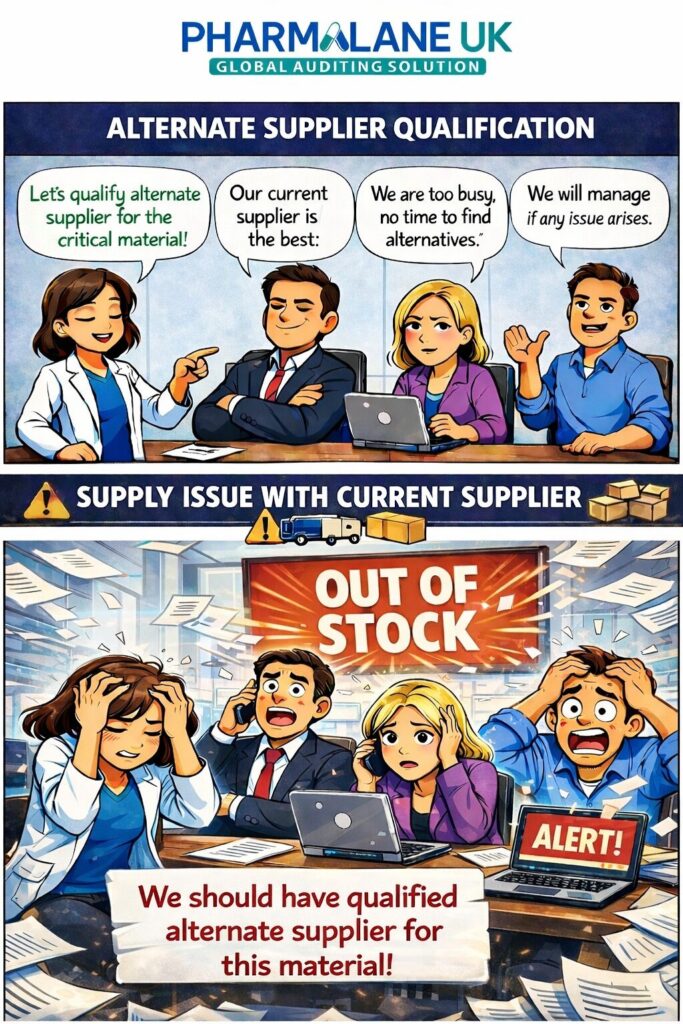
For too long, qualifying an alternate source was viewed as a costly and time-consuming “nice-to-have” while today, it is a strategic imperative. It is no longer a question of if a disruption will occur, but when. And when it does, the robustness of your supply chain and your preparation in qualifying backups will determine your ability to protect patients and maintain business continuity.
The distinction matters more now than it ever has.
We Know the Risks. The Question Is Whether We Have Acted on Them
The dependency risk associated with single-source supply is not new intelligence for anyone working in pharmaceutical quality. ICH Q9(R1) gives us the framework to assess it. ICH Q10 gives us the system architecture to manage it. EU GMP Chapter 7 and FDA 21 CFR 211.84 establish the regulatory floor for what oversight is expected. The pharmacopoeial and dossier implications of adding an alternate source are well understood by anyone who has navigated a Type IA/IB variation (or equivalent) or a Prior Approval Supplement.
What is worth examining more critically is the gap between knowing the risk and actually closing it.
In many organizations, the Approved Supplier List contains exactly one qualified source for a significant proportion of critical starting materials, key excipients, or primary packaging components. The risk is documented flagged in a risk register, noted in a CAPA, perhaps referenced in a management review presentation but the qualification of a genuine, operationally ready alternate has been perpetually deferred. The business case is approved in principle but not funded in practice. The project is initiated and then deprioritized when bandwidth contracts. This is not a quality system failure in the traditional sense hence the deviation is not raised as the procedure is not violated however it is a failure of risk management at precisely the level where quality leadership has the most influence.
The translation of risk awareness into risk action is imperative and that is where the accountability lies, and it is where this conversation needs to be directed.
What Robust Alternate Qualification Actually Looks Like — Beyond the Checklist
For an audience of quality professionals, the mechanics of the qualification process itself need little explanation. What is worth examining is the depth at which those mechanics are applied because this is where the meaningful variation between organizations occurs.
A supplier assessment questionnaire is a screening tool, not a qualification instrument. A desktop review of regulatory certificates and inspection outcomes is necessary but fundamentally backward-looking. Even an on-site audit, if conducted to a superficial standard rather than by skilled auditors, will produce a report that documents compliance artefacts without genuinely probing system effectiveness. Third-party auditing consultancies, such as PHARMALANE UK, are essential when organizations lack sufficient expertise and resources to carry out these audits effectively.
The Audit Characteristics That Actually Generate Confidence
The audits that generate real qualification confidence share certain characteristics that go beyond procedural execution:
- Investigative depth: Not by reviewing the deviation or complaint procedure, but by pulling a sample of closed deviations and asking in the room why the root cause attribution is what it is, and what evidence supports it.
- CAPA effectiveness rigor: Examining whether the verification criteria defined at CAPA initiation were actually applied at closure, or whether closure was effectively administrative.
- Change control as a leading indicator: Assessing whether the organization genuinely understands what changes carry quality risk and whether the appropriate controls are applied or merely documented.
- Data integrity culture, not just ALCOA+ compliance: How hybrid systems are managed, how audit trail review is conducted and documented, whether metadata is genuinely understood and protected, and how the organization responds when a data integrity concern is identified internally.
KEY INSIGHT
An alternate manufacturer whose data integrity posture is fragile will eventually create a problem that lands in your quality system and the consequences, reputational and regulatory, will not be confined to their facility.
For a potential alternate manufacturer, these systemic signals tell you whether the site will perform reliably under operational pressure which is precisely the condition under which you will most need them.
Technical Comparability: Where Qualification Programs Most Frequently Fall Short
In general, quality experts will feel at ease with QMS evaluation. The rigor of technical comparability evaluation is where alternative qualification programs typically fall short, especially for complex materials where there is a non-trivial link between process parameters, impurity profiles, and final product performance.
This presents a structural risk. While quality staff are well-versed in the Quality Management System (QMS), analytical scientists contribute strong technical expertise, and regulatory affairs teams hold detailed knowledge of the dossier, these functions often operate in sequence rather than in true integration. As a result, the technical evaluation that supports regulatory submissions and ultimately commercial release decisions may not be sufficiently robust for the risk profile of the substance.
For APIs with complex synthetic routes, for excipients with functionality-related characteristics affecting dissolution or bioavailability, for packaging materials where extractable and leachable profiles are part of the approved dossier, the technical qualification must be designed by people who understand what the product specification is actually measuring and why.
The audit of the alternate manufacturer must inform and be informed by that technical assessment. These are not parallel workstreams that converge at a qualification decision meeting. They need to be genuinely integrated.
The Indispensable Role of Third-Party Auditing Groups
The value proposition of third-party auditing does not need to be explained to this audience in terms of filling resource gaps or providing geographic coverage. You know what independent audit provides. What is worth articulating more precisely is what it provides that internal audit structurally cannot not be due to capability, but due to context.
Internal quality teams operate within an organizational system. Commercial relationships, internal advocacy, timeline pressures, and the accumulated history of a supplier relationship all exist as background context when an internal auditor assesses a prospective alternate. The risk is not that internal auditors are commercially captured as most of them are not. The risk is subtler: that the framing of risk findings is influenced, even unconsciously, by the organizational weight behind a qualification decision that has already gathered momentum.
A specialist third-party auditing group like PHARMALANE UK operates independently and effectively without that context. Our mandate is an honest and thorough assessment, not facilitation. Our reputation rests on the accuracy and integrity of their findings, not on the speed of a qualification decision.
What Expert Third-Party Auditors Specifically Bring
- Depth of technical & auditing expertise across multiple regulatory frameworks
- Objective, evidence-based assessment
- Comprehensive QMS evaluation
- Technical and capacity assessment
- Risk identification and stratification
- Regulatory intelligence
- Scalable global coverage
The Regulatory Direction of Travel — Reading Between the Lines
Regulatory agencies are not simply raising the bar on supplier oversight in general. They are specifically signaling expectations around supply chain diversification and proactive risk management that quality professionals should be reading carefully.
The EMA’s work on medicine shortages, the FDA’s Drug Shortages Staff Manual updates, and the increasing focus on supply chain sections in GMP inspection programs, all point toward a regulatory environment in which an organization’s single-source dependencies are viewed as a quality system characteristic, something that reflects the maturity of risk management, not merely the state of commercial negotiations.
Inspection observations relating to inadequate supplier oversight specifically the absence of periodic re-qualification, insufficient risk assessment of critical suppliers, or approved supplier lists that have not been reviewed against current supply risk are becoming more frequent. For organizations whose quality systems have historically treated supplier qualification as a one-time approval event rather than a continuous oversight activity, this shift in inspection focus represents genuine exposure.
The Strategic Positioning That Quality Leadership Needs to Own
For quality leaders, the qualification of alternate manufacturers and suppliers represents one of the clearest opportunities to demonstrate the strategic value of the quality function in business terms. Supply chain resilience has never been higher on the agenda of pharmaceutical executive teams and boards. The COVID-19 experience, ongoing geopolitical uncertainty, and increasing regulatory pressure have created an organizational appetite for exactly the kind of risk-based, evidence-led supply chain programme that quality professionals are best placed to lead.
The framing is crucial. This is not a compliance program; it is a risk management program with direct implications for business continuity, regulatory standing, and patient access to medicines. It necessitates the rigorous and independent assessment that only a mature quality function, supported by specialized external audit expertise, can credibly provide.
If the alternate qualification programs in your organization are not being driven from quality if they are being defined commercially and quality is being brought in to execute a predetermined approval, then the independence that makes qualification meaningful is already compromised.
The supply chains that will perform reliably through the next disruption, whatever form it takes, will be the ones where that professional rigor was sustained when it was inconvenient to do so.
In Closing — A Question Worth Sitting With
The pharmaceutical industry has the knowledge, the frameworks, and the regulatory guidance to build genuinely resilient, well-qualified supply chains. What it periodically lacks is the organizational priorities and time and resource investment when the immediate pressure is elsewhere.
The professionals best placed to maintain that priority to push back when timelines are compressed, to insist on audit depth when convenience argues for a desktop review, to commission independent assessment when internal bandwidth or context argues against it are the quality professionals reading this.
That is, ultimately, what the quality function exists to provide. The question for every quality professional is not whether to qualify alternates, it is whether the programme you have today would actually protect your patients when the primary source fails tomorrow.